Behind the scenes#
For the curious: where RPG Tsukuru 4 comes from, what is on its discs, what was left in them unused, the games made with it at the time, the guidebook, and how the project behind this guide took the game apart. None of it is needed to make a game.
The family#
RPG Tsukuru ("RPG Maker") is a Japanese series of game makers. On the PlayStation, RPG Tsukuru 4 follows RPG Tsukuru 3.
- RPG Tsukuru 3 (SLPS-01093, 1997) came first. It could take songs from a companion disc, Kanadeeru 2, and graphics from its built-in Animetica.
- RPG Maker 1 (SLUS-00640, published in America by Agetec) is RPG Tsukuru 3 translated. The song import was cut, the kanji font went unused, and Animetica became Anime Maker. Coming from RPG Maker 1 compares it with RPG Tsukuru 4.
- RPG Tsukuru 4 (SLPS-02861, 2000) is by Enterbrain and argent: hence the argent logo after Enterbrain's at power-on, and "© 2000 ENTERBRAIN, INC. / argent" on the title screen. It takes songs from Music Tsukuru 3, a separate disc, and graphics from Character Tsukuru on its own second disc, made with Spline.
RPG Tsukuru 4 never left Japan: after RPG Maker 1, America's next RPG Maker was on the PlayStation 2. Some of the family shows through. Character Tsukuru runs on Animetica's engine and still names its files the way Anime Maker did, and RPG Tsukuru 4 packs its saves with the same compressor as RPG Maker 1's Anime Maker. Both games drive the sound chip through the same library, and given the same song they play it identically; what changed is how RPG Tsukuru 4 sets it up (Music and sound).
What's on the discs#
| Disc | File | Size | What |
|---|---|---|---|
| 1 | SLPS_028.61 | 540 KB | The program: the editor and the player are one |
| 1 | CDDATA.PCK | 56 MB | Everything else in 1,073 files: graphics, map sets, songs, the sound banks, the sample game and six pieces of program code |
| 1 | MOVIE2/MAGIC2/ | 36 MB | 32 spell movies |
| 1 | MOVIE2/SUMMON2/ | 92 MB | 29 summon movies |
| 1 | DUMMY. | 26 MB | Zeros, to fill the disc |
| 2 | SLPS_028.62 | 640 KB | Character Tsukuru's program |
| 2 | ANM*.APK, DATA.NPK | about 1 MB | The editors' screens, buttons and fonts |
| 2 | MEMCARD.APK, MEMCARD.LPK | 530 KB | The memory card screens, with the guide girl |
| 2 | SAMPLE.DAT, SAMPLE.IDX | 13 MB | The sample library: 448 ready-made graphics to load and change |
| 2 | DUMMY.DAT | 32 MB | A prototype's memory card screens, 64 times over (below) |
Neither disc has CD audio: the music is sequenced, played on the console's sound chip from two banks of instruments loaded at power-on. The movies carry their own sound.
The first disc is one program, editor and player together, which loads pieces of its code from the pack as you move between the play menu, a game, the System editors and the map and event editor. While a game plays, the battle engine stays loaded, so a battle starts without a load. The first picture comes about 8½ seconds after power-on, with no movie: only Enterbrain's and argent's logos, once per power-on.
The second disc boots as Character Tsukuru. Its volume carries no name or serial of its own; its program file follows on from the first disc's number.
DUMMY.DAT#
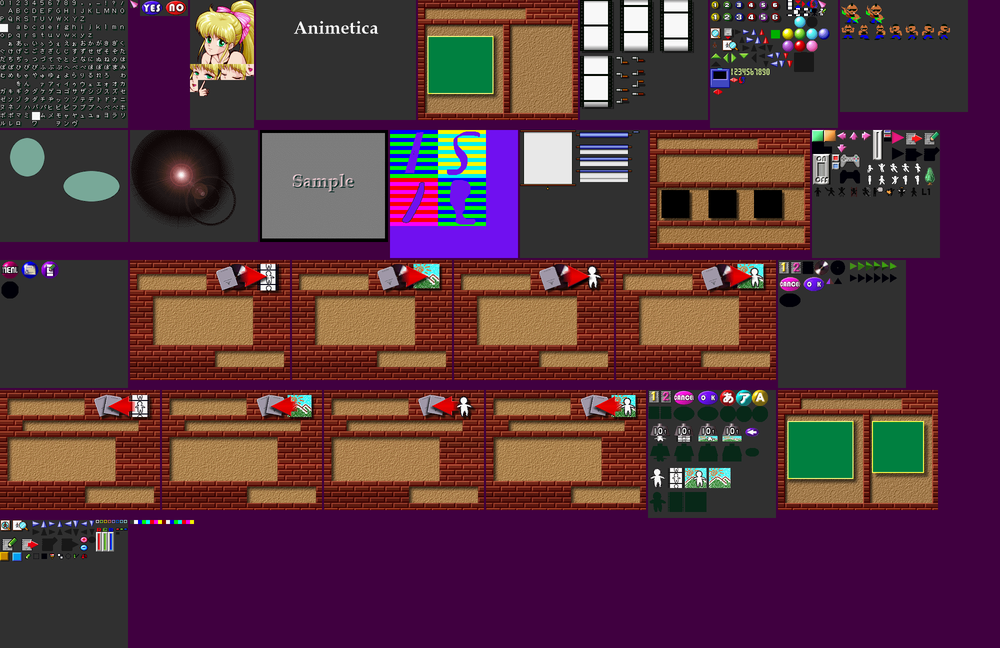
The second disc ends with a 32 MB file that nothing reads, apparently there to fill the disc. It isn't empty: it is 64 copies of an early version of Character Tsukuru's memory card screens, from before the program had its own name and look.
- A logo reads Animetica, and the save template is titled "Animetica character data": the program was still carrying its parent's name.
- The panels for each kind of data are red brick walls where the release has cork boards, with plain figure and landscape icons.
- There are film-strip frames, a lens flare, a projection screen and a striped test pattern that the release doesn't have.
- The guide girl is already there, but redrawn later: her ribbon is pink here and blue in the release.
Unused and unreachable#
Things finished or half-finished that a player or a game maker can't reach:
| What | Where |
|---|---|
| A fourth title font | The title editor's font icons have a fourth, ア over キ, that nothing draws. A fourth font, set only by editing the data by hand, would load a battle weapon's picture as its letters (read from the code, not tried) |
| Release | The capacity that frees a captured monster. The Class Editor's list skips it, so no class can teach it |
| Vehicles 13–15 | The saved data has room for 15 vehicle graphics; the files after the twelfth are the title fonts |
| A Special Command row | The field menu's Class screen has the code for choosing a special command, list and all, but no window shows the row |
| A fourth Wait | Test play's bar labels a Wait by what it stops. A fourth kind, which the editor never offers, shows its count with no label |
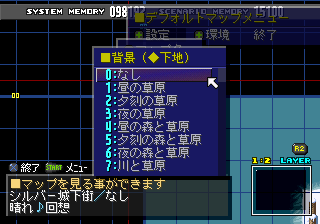
| An older Background menu | A map's Background was once picked from a list of its own, numbered from 0. The menu and its code are still in the program, but the Background row now opens the general list (below) |
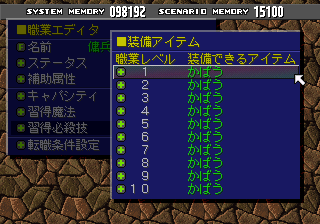
| An Equipment page for classes | The Class Editor has a finished window, Equipment, for the items each class level lets a hero equip, between Special Skills and Class Change Conditions. No row opens it and no code fills it; classes have no such setting (below) |
| Lowering experience | Change Hero Status has a number entry for experience from −9,999,999 to 9,999,999 that no row opens: the Experience row adds only (0 to 9,999,999). Taking experience away was probably planned (read from the code) |
| Two pictures nothing shows | The graphics loaded at power-on include a "?" panel and a strip of rubble, which no screen draws (below). Checked by painting them over in the emulator's video memory and replaying more than 700 saved moments of play and editing: none showed them |
| A battle from the play menu | The play menu's code can start a battle that no choice leads to. Forced, the screen stays black and the battle never ends: perhaps a test from development |
| Three controller settings | The game still obeys three settings whose code to change them was removed: lock out a controller, make other buttons count as ○, and stop the left stick from moving the cursor. Tried by setting them in an emulator: × worked as ○, and a locked controller did nothing |
| An older Class Change Conditions page | Code that fills in Item Needed and Class Before one row higher than they sit now, written before Switch Needed was added above them. Run in an emulator, it puts the class into Item Needed's row |
| Curing one ailment | Change Hero Condition can only cure every ailment at once. The code for curing one at a time is in the program, unused (read from the code, not tried) |
| A two-player vibration | Code to make either controller shake, on either motor. Vibrate only ever shakes the first controller (read from the code, not tried) |
| "Checking memory card" | A window with this message that no screen opens: the card screens go straight to their results |
| Music nothing plays | 34 of the 105 instruments in the music bank are played by none of the 40 songs on the disc. They are there for songs imported from Music Tsukuru 3 |
| Development leftovers | A hex number printer; a timer the save decompressor still runs, with nothing left to read it; and messages written to a development console that the screen never shows, such as "start error" for an event damaged by hand. A staff member's name is written into every block of copied commands, as the tag the game checks when pasting |
| Disc 2: a debug mode | Character Tsukuru has a developers' mode, switched off when the program starts. Turned on in an emulator, it shows a console of timings and memory use over the screen, and a second controller pans the picture, freezes and single-steps the program (below) |
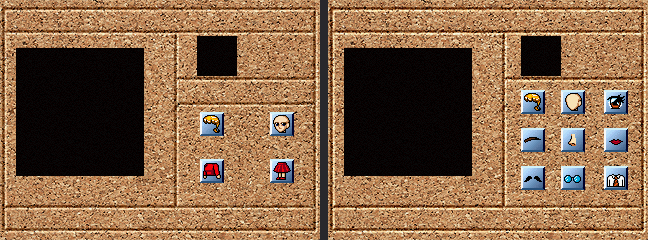
| Disc 2: two unfinished parts editors | Two cork-board screens that nothing loads: one builds a face from nine kinds of part (hair, outline, eyes, brows, nose, mouth, moustache, glasses, clothes), the other a body from four. There is no code for either: only the pictures were made (below) |
| Disc 2: a coloured template | A full-colour character sheet laid out like the white body template that LAYER can put behind a drawing. The program always loads the white one (below) |
| Disc 2: kana for names | The name keyboard has pages of hiragana, katakana and capitals beside the digits and letters, with the あ / ア / A buttons left for switching between them. Switched on in an emulator, the pages work, but some katakana have no letters drawn. Probably dropped because memory card file names must be in Latin letters (below) |
| Disc 2: three sound effects | The sound-effect set has six sounds; the program only ever plays three |
| Disc 2: a button panel | A file of buttons and check boxes that the program never loads: the palette window of an older layout of the paint screen |
| Disc 2: a development PC | File modes for reading from a development computer instead of the disc, and messages written for a development console |
The project found these in a search of both programs for code that nothing calls, text that nothing prints and files that nothing loads (the project's notes have the full list, dead code included). The ones below were switched back on in an emulator, by changing a value in memory, to see what they do.
An older Background menu#
A map's Background row opens the general list the editor uses for songs and other numbered things. An older menu of its own, Background (◆ base), is still in the program with the code that fills it and applies the choice. Pointed at from the Background row in an emulator, it opened and listed the backgrounds from 0. A choice made in it doesn't stick, though: the code behind the Background row now reads the general list's answer instead, so the map got background 127, which doesn't exist, and showed garbage.
An Equipment page for classes#
The Class Editor's windows include a finished Equipment page: Class level / Items it can equip, rows 1 to 10, cut from the same pattern as the Special Skills page beside it. No row of the editor opens it and no code fills it. So classes were once meant to unlock equipment by level, as they unlock spells and skills. Opened in place of Special Skills in an emulator, it shows every row as the first special skill's name, Cover, and ○ on a row opens the capacity picker it was copied from.
Two pictures nothing shows#
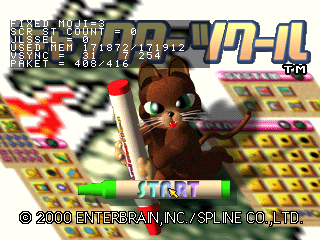
The graphics loaded at power-on, which stay in video memory for the whole session, hold two pictures that no screen draws: a blue "?" panel, perhaps a placeholder for a missing picture, and a strip of rubble in three sizes beside a striped panel. To be sure, both were painted a solid colour in video memory and the project's 712 saved moments of the game were each played on for half a second with and without the paint: no screen changed.

Character Tsukuru's debug mode#
The second disc's program has a developers' mode that its start-up code switches off. Switched on in an emulator, it puts a console over every screen: frame timing, the drawing buffer's use and memory in use. A second controller then works the debug keys: □ cycles the console, the d-pad slides the whole picture around the screen and R1 puts it back, SELECT freezes the program and START steps it one frame. △ saves a screenshot to a development computer attached to the console. Without one, as on any normal console, the program can't open the file, writes anyway and crashes (tried in an emulator).
Kana for names#
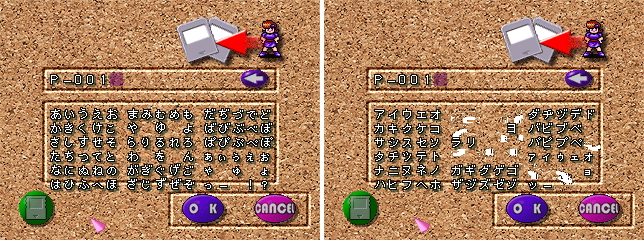
Character Tsukuru names a file with digits and Latin letters only. Its name keyboard has three more pages, hiragana, katakana and capitals, with buttons for switching between them still on the screen. Opened in an emulator, the hiragana page is complete; the katakana page has holes where the program's small font has no letter. Memory card file names have to be in Latin letters, which is probably why the kana went.
A coloured template#
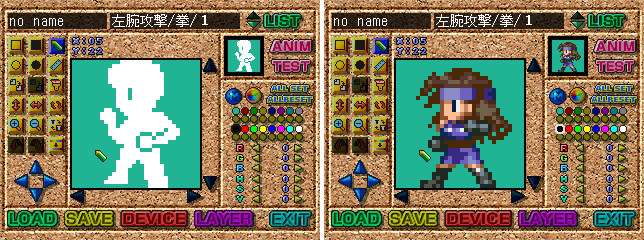
In the character editor, LAYER → PRESET puts a white body template behind the drawing to trace over. The disc also holds a full-colour template in the same layout, an earlier version of one of RPG Tsukuru 4's sample characters, and the code takes the template's number as a setting; every call passes the white one. Switched in an emulator, PRESET put the coloured character behind a blank canvas.
Two unfinished parts editors#
Two more screens on the second disc are never loaded: a parts editor for faces and one for bodies, each with a large preview, a portrait-sized one and buttons for the kinds of part. There is no code behind them, so only the pictures were made.
The random numbers#
RPG Tsukuru 4 draws all its random numbers from one sequence that starts in the same place at every power-on and is never stirred by a clock. Battles, random walkers, odds branches and items that may break all take from it. So the same button presses on the same frames from power-on give the same game, battle for battle. That is what let the project record test runs and replay them exactly. The place in the sequence isn't saved either: a game loaded from a card goes on from wherever the console has got to.
RPG Tsukuru 4 games of the time#
Players shared their games as memory card images, put up on fan sites in LZH archives (the ones the project found are dated 2001), and later as self-extracting archives in the GCA format, contest entries among them. Three games could be opened and played; about a dozen more wait in GCA archives that haven't been unpacked. The guide describes them by kind only.
- A card-battle game in five Scenarios: building a deck, two players against each other, a player against the console, an extras room and a tutorial.
- A slot-machine game in three Scenarios, its System and every Scenario behind a password. It renames the hero's level as a count of wins.
- A story told across three eras, which renames the field menu's rows and the currency.
They filled their Scenarios to 92–99% and split their games across several. They had few monsters or none: two of the three have no random battles at all. They opened in ways the sample doesn't: a save point as the very first event, an undrawn map as a black backdrop, a Scenario change as soon as the game begins. One card shows how fragile sharing was: a copy made three months later has damaged entries in the card's file list, which hide its three Scenarios from the game, so a new game asks for the card for ever (seen in the emulator; a real console wasn't tried).
The guidebook's back pages announce Enterbrain's 5th game contest, open from November 2000 to March 2002.
The guidebook#
The official guidebook is 『RPGツクール4 公式ガイドブック』, edited by the Famitsu staff and published by Enterbrain, first edition 2 February 2001, ISBN 4-7577-0323-6. It runs to 275 pages: the System and Scenario editors, worked events, the catalogues of map sets and graphics, and planning worksheets. This guide follows its chapter order and cites its pages, but is written independently.
The book was written from a build close to the release, by writers using the editor, not from the program. Its catalogues (names, counts and order) match the disc. Where its explanations don't match the game, the project checked them in play: Corrections to the guidebook lists what it found.
The project#
This guide comes out of a preservation project that set out to understand RPG Tsukuru 4 completely, and then to translate it. It follows an earlier project that did the same for RPG Maker 1 and RPG Tsukuru 3, and reuses its tools.
Reading the code. The game's program was taken apart in a disassembler and read function by function, until every system was understood: the editors, the event language, battle, maps, sound, text, the memory card and the save formats. Each finding was written down with what it rests on. Tools were written to read every kind of file on the discs and every save, and they read every memory card the project could open, fan games included, down to the last byte.
Testing in an emulator. Nothing was taken on the code's word alone where it could be tried. The game ran in an emulator driven by scripts: button presses, test Scenarios written by tool, values changed in memory, the screen and the sound checked against what the code predicts. Because the random numbers repeat, a scripted run from power-on gives the same game every time, so two dozen recorded runs, from the title to battles, saves and game overs, could be replayed after every change to show that nothing had moved.
The patch was built on that understanding: the translation, the English font and keyboard, room for bigger games and the bug fixes (The English patch). Its changes are checked against the same recorded runs, on the original disc and on the patched one. The guide's screenshots are taken the same way, by script, on both discs.
Fan-made reference material, one of the Eschaton Games Tsukuru guides. Not affiliated with the publishers of the titles it covers.