What the patch adds#
The English patch is a translation first, but it also changes what RPG Tsukuru 4 can do: it gives a game far more room, raises the limits, adds to the event commands, adds a few features in play and in the editor, saves to the memory card in less space, and fixes bugs in the original. Those changes are spread over the guide, each where it belongs. This page gathers them: a summary first, then each area with its figures, and links to where the guide covers it in full. The English patch shows the translation itself, screen by screen.
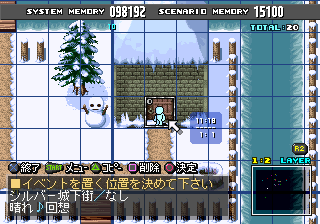 Original (Japanese)
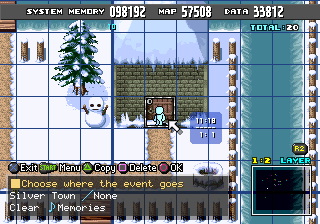 English patch
At a glance#
- Bigger games. A Scenario holds about four times as much as the original allows. Only the map being edited or played sits in the original's room; the rest are packed away in memory the original left unused. A save may take the whole card.
- Higher limits. Four times the switches (2,048) and variables (1,024); 255 items, maps and monster placements; 100 special moves; 90 pages an event and 1,000 commands a page.
- More in events. Ten commands do more: arithmetic and game data in Variable, events called as subroutines, 120 common events, item counts, map changes and moves to a cell taken from variables, stats set rather than added to, a variable shown on screen, and more.
- New in play. The music plays on across a change of place, the player can name a hero, the field menu can have Order and Save, two battle options, smoother battles, and three settings: Use × to Confirm, Wait in Battle Menus and Battle Speed.
- New in the editor. The MAP and DATA counters, a command clipboard that lasts the whole session, the player's three settings for test play, and a Vigor Curve that sets how much Vigor speeds a battler up.
- Smaller saves. A game save takes 1 block instead of 2, the sample's Scenario 2 instead of 3, and a System packs smaller.
- Character Tsukuru's graphics in less space. Its saves are packed more tightly, an edited CD-ROM sample is saved as just its changes, and the art file packs a game's graphics together: every External Data slot filled takes 2 memory cards instead of 5.
- Fourteen bugs fixed, from instruments that went silent to a hang in the map editor.
- What it costs. Japanese text in a game's own data draws as boxes, and a game made with the patch needs the patch to play (below).
Room for bigger games#
The original keeps a whole Scenario in one room of 65,040 bytes, and every event, page and command takes some of it. Players remember RPG Tsukuru 4's limits as much tighter than RPG Tsukuru 3's, and they are right: a full Scenario holds roughly a sixteenth of the event pages a full RPG Tsukuru 3 Scenario could.
The patch keeps the original's rules but moves where the events live. Only the map you are editing or playing sits in the original room; every other map's events are packed and kept in memory the original left unused or spent on the Japanese font. Maps are packed and unpacked as you move between them, which you don't notice in play.
| Original | Patched | |
|---|---|---|
| A Scenario's room | 65,040 bytes | about four times as much |
| The largest save of a Scenario | what fits the room | the whole card, 15 blocks |
| The editor's counter | SCENARIO MEMORY | MAP (this map's room) and DATA (the whole Scenario's) |
| Monsters, spells and items | stored more compactly: a System with every list at the original's maximum still fits the original's room |
Most games no longer need to be split into several Scenarios. Splitting still works as before, with Change Scenario (A game in several Scenarios). In full: Room for bigger games, How much fits.
Higher limits#
| Original | Patched | |
|---|---|---|
| Switches | 500 | 2,048 |
| Variables | 256 | 1,024 |
| Items | 200 | 255 |
| Special moves | 50 | 100 |
| Maps and monster placements | 250 | 255 |
| Pages an event | 30 | 90 |
| Commands a page | 250 | 1,000 |
| Common events | none | 120 |
| Calls that return | none: Call Event only jumps | up to eight deep |
The editors' lists, the dialogs that pick a switch or a variable and the player all take the new counts. Switches 2045 to 2048 have a use of their own: see New in play. In full: Larger limits, Limits, bugs and workarounds.
More in events#
Every command the original has still does exactly what it did. The new forms are new rows in each command's own dialog, so nothing changes unless you choose one.
| Command | What the patch adds |
|---|---|
| Variable | Multiply, divide (rounding toward zero) and remainder; a random value in a range you choose; 27 more things to read from the game, such as a hero's stats, the party's money or the play time |
| Call Event | Call (return): runs another event's page as a subroutine, then carries on with the next command, where the original's call only jumps |
| Common events | Up to 120 events kept with the System, which any map's events can call: write a shop or an inn once |
| Change Items | A count of up to 99, or as many as a variable holds |
| Change Map | The map and cell from three variables, so one door's destination can be worked out |
| Move to a Spot | The cell from two variables, and At Once to place the party or the event there without walking |
| Hero Stats, Hero Condition | Set a stat or points instead of adding to them, from a variable if you like; Level too |
| Fight Monsters | Random Battles: sets the random battles' background, music and steps between them |
| Show Timer | Show Variable: a variable's value on screen in one of two slots, with an item's name before it |
| Rename Hero | A name starting with ? lets the player type it |
| Has Hero page condition | Can ask for the hero's Class as well |
In full: More in events, The commands, Common events, and four recipes that use them in Event recipes.
New in play#
- The music plays on. A change of place or a BGM command that asks for the song already playing, at the same volume and tempo, lets it carry on instead of starting again from the top. This is the one change a game gets without asking for it.
- The player names a hero. Rename Hero with a name starting with
?opens the name keyboard in play. - Order and Save in the field menu. Order swaps two party members; Save opens the save screen anywhere. Each is set by a switch, so a game keeps its save points unless its author chooses otherwise.
- Two battle options, each off unless its switch is on.
- Smoother battles. A spell's or summon's movie no longer holds the battle to 15 frames a second, with a freeze as it starts: the battle draws on at or near full speed while it plays, and the movie shows every frame. The pause as a battle is won and the stall on each line of the rewards are gone, and the battle clock keeps real time when the game falls behind.
- Three rows in the field menu's Settings, kept in the player's save (Settings):
- Use × to Confirm: × confirms and ○ cancels, as in Western PlayStation games.
- Wait in Battle Menus: the battle clock also stops while a hero chooses a target or has a list open, such as MAGIC or ITEM. The command ring itself still runs. Off to start.
- Battle Speed, a slider from 50% to 150% in steps of 25 (100% is the original's pace). It scales how fast every gauge fills, the heroes' and the monsters', and how fast spells are cast: at 150% everyone acts half as often again, at 50% half as often, leaving twice the time to choose.
| Switch | While it is ON |
|---|---|
| 2045 | The field menu has no Order row |
| 2046 | The field menu has a Save row |
| 2047 | Physical damage varies by up to ±10%, as in RPG Maker 1 |
| 2048 | Each hero still standing gets the battle's whole EXP and class points, not a share |
Keep these four switches for this, and name them in the Switches list. In full: New in play and in the editor, The field menu, Winning and losing.
New in the editor#
- MAP and DATA. Once the event editor has been opened, the counter at the top shows the room left on the map you are editing and the room left for the whole Scenario (The memory counters).
- The command clipboard lasts. Commands copied or cut can be pasted on any page of any event or map until the console is switched off, even after test play or a save. A branch with another branch inside it pastes cleanly.
- The player's three settings in the Editor Settings, for test play and test battles: Use × to Confirm (for the editors too; the button hints swap with it), Wait in Battle Menus and Battle Speed (Editor Settings).
- The External Data screens add the art file's rows: Add to art on a save; Register, Export, Remove and Tidy on a graphic in the art.
- Files are found by their whole name. The original took the first file whose title started with the name it wanted, so TEST could load TEST2. The patch matches the whole name (How the files find each other).
- Vigor Curve, a new row of System Settings with a window of its own (The Vigor curve). Vigor is the stat that sets how often a battler acts (Spirit in the patch's earlier releases). In the original a gauge fills by Vigor ÷ 2 + 1 each frame, so Vigor 0 is fifty times slower than Vigor 99. The window lets a game choose its own curve, kept with the System Data; left off, nothing changes. Agility is unchanged: it still counts for escaping, dodging and the first strike.
| Row | What it does |
|---|---|
| Custom Curve | Ticked, the curve below is used; unticked, the original's. Spread and Shape are grey while it is off |
| Spread, 1–16 | How many times slower Vigor 0 is than Vigor 99. Vigor 99 always keeps the original's speed; Spread 1 makes everyone equally fast |
| Shape, −2 to +2 | How the speed climbs between them: 0 a straight line; below 0 slow until high Vigor; above 0 most of the speed reached by middle Vigor |
| Five bars | Turns a minute at Vigor 0, 25, 50, 75 and 99, at normal Battle Speed. They follow each change as you make it |
Saves and the memory card#
A card has 15 blocks and room for 15 files. The patch saves everything in its own, more compact formats.
| What | Original | Patched |
|---|---|---|
| A game save (or test play's) | 2 blocks | 1 block |
| The sample's Scenario | 3 blocks | 2 blocks |
| A Character Tsukuru character, of the 135 samples | 1 block for 15 of them | 1 block for 86 of them |
| All 448 Character Tsukuru samples | 694 blocks | 589 blocks |
| A CD-ROM sample edited and saved | as many as the whole picture takes | 1 block, but for an LL monster |
| Faces, magic effects and slashes, 27 of them | 27 blocks in 27 files | about 2½ blocks in one art file |
| Every External Data slot filled, 53 graphics | about 72 blocks on 5 cards | 26 to 28 blocks on 2 cards, in the art file |
- Character Tsukuru's packing. The patched second disc packs its saves more tightly, so most graphics take a block less.
- Edited samples. A sample you load from the CD-ROM, change and save is kept as only what you changed, and is read back against the sample. The first disc's patch carries its own copy of the samples so that RT4 can do the same.
- The art file. RT4 can gather a game's graphics into card files of its own, parts, each holding up to 30 graphics in up to 15 blocks, every graphic taking only the room its picture needs. The System still names each graphic by its save, so a save can be added to the art and then deleted without registering anything again.
In full: Saves, Saving and loading, The art file, Memory cards.
Bugs fixed#
The patch fixes fourteen bugs of the original where the fix is small and safe, each checked in play before and after:
- Music: a memory-card song that fades an instrument out leaves it silent in every later song.
- Battle: Forced AI never heals; cancelling support refills a monster; the results list a dropped item twice.
- Events: Widescreen barely moves on its own; a Change Map during a wait stops every event on the new map; a random Variable isn't 0–999; a cleared torch or circle light comes back; Approach and Flee walk at random.
- Maps: Wavy BG shows the wrong slice of the picture at the screen's edges, and can overrun the drawing memory on a busy map.
- Editors: saving an item takes it off every monster that can have it stolen; editing a special move fixes up references as if it were a spell; an event's name is lost when its destination is picked on another map; the attribute view can hang the editor.
In full, what each did and what the patch does instead: Bugs fixed, Fixed by the patch.
What a patched game needs#
The patch reads everything the original made. The original can't read what the patch makes.
| Made with | On the original RT4 | On the patched RT4 |
|---|---|---|
| The original editor: System, Scenario, saves | plays | plays: its Japanese text draws as boxes |
| The patched editor: System, Scenario, saves | reported as broken data; nothing is lost | plays |
| The original Character Tsukuru's saves | registers them | registers them |
| The patched Character Tsukuru's packed and edited-sample saves | reported as damaged | registers them |
| Graphics in the art file | doesn't see them | registers them |
So a game made with the patch needs the patch to play, and so does a game with graphics from the patched second disc or the art file. Share the patch with the game, or point players to it.
What it costs#
- Japanese text draws as boxes. The patch drops the Japanese font, the kana keyboards and the kanji dictionary to make room for the English font, the translation and the features above. It is meant for making new games in English, not for playing Japanese fan games.
- The Roman numerals Ⅰ–Ⅹ are gone from the keyboard's symbol page: the patch's font doesn't have them.
- The first disc's patch is about 3 MB, for its copy of the second disc's samples. The second disc's is about 40 KB (Getting the patch).
- One known fault is left as it is: a magic effect or slash registered over a filled slot loses the old one if the new file can't be read. Keep a copy of your System Data before replacing one.
Fan-made reference material, one of the Eschaton Games Tsukuru guides. Not affiliated with the publishers of the titles it covers.